Posts

Hunger Games Final Analysis
Image
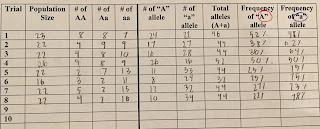
1. In this lab, we simulated a real world population. For this species to survive, they have to eat and survive in order for their population to not go extinct. 2. The phenotypes that were in this population were the stumpys, knucklers, and pinchers. The phenotype that was the best at capturing food were the pinchers. They had the most precised way of picking up foods, while the other two struggled with the handling of foods. 3. The population did evolve. The "a" allele became more common than the "A" allele. During the first trial, they were almost equal, but eventually the "a" allele surpassed. The last trial shows that the gene frequency of the "a" allele was around 78%, making the "A" allele at 22%. 4. A factor that was random was the placement of food. Depending of the scatterness of the food, the different phenotypes could have had an advantage. An event that was not random was the time we had to collect the food. Every ph...

20-Time: Slippery Setback (Part 2)

My original plan for my 20-time project was to have an Earth day fair and inform students about environmental issues. Unfortunately, it was unrealistic to think that I could get a day, let alone a week, to educate my peers. I have two ideas to replace my project, but have been struggling to choose which one would be better. The popular, Taiwanese-tea based drink goes by many names: boba tea, bubble tea, pearl milk tea. Whatever you call it, you are familiar with its contents, the little black balls of starch. Also, known as tapioca pearls, these chewy spheres are extracted from cassava roots, native to the north region of Brazil, and now spreading throughout South America. It is said tapioca pearls are “one of the purest forms of starch food”. A german study shows these pearls are linked to cancer. The cancer-causing chemicals are known as polychlorinated biphenyls or PCBs. The tests were held in Taiwan, where the toxic man-made chemicals are made. American producers for tapioca...

Unit 7 Reflection

Image
This unit was about ecology: the interaction between organism and their environment. In all environments, there will always be producers and consumers. In a food chain or web, the consumer or producer is shown obtaining energy from something else, but that doesn't necessarily mean an organism. Energy can also be found from photosynthesis or the primary producers in an ecosystem. When a product is consumed, only ten percent will be passed on to the next trophic level. More into depth about organism, we learned about population and the factors that impact the amount of organisms. Immigration, births, emigration, and death are all factors that can fluctuate the statistics. Our world is almost reaching its carrying capacity, the maximum population size the environment can hold. Today, we have about 7.5 billion humans in the world, but it is said that our carrying capacity is 14 billion. We are over HALF way there! What is going to happen when we reach that limit? The nutrient cycles- w...

The Beginning of 20-Time (Part I)

Image
What is 20-time? Glad you asked! In Mr. Orre's biology class, we are working on a long term project that we are passionate about for 20% of our class time each week. By the end of this project, the goal is to achieve a solution to the problem you are concerning or complete a major portion for a greater good. My 20-time doesn't have an essential question, but a dream goal: I want more people to be aware of their surroundings and the planet we live on. I feel that most people would use an educational pamphlet to hold their half chewed gum or a google slide would be nap time for high school students. My 20-time is educating Saratoga High students and making them more environmentally conscious with a whole week (during the week of Earth Day) dedicated to problems affecting the environment, such as energy conservation, pollution, ocean waste, etc. At the end of the week, we could have a fair with different booths, similar to a club day, but more about the environment. This project...

pGLO Lab

Image
pGLO Observations , Data Recording & Analysis 1. Obtain your team plates.  Observe your set of  “+pGLO” plates under room light and with UV light .  Record numbers of colonies and color of colonies. Fill in the table below. Plate Number of Colonies Color of colonies under room light Color of colonies under UV light - pGLO LB 8 Tan-ish/white, opaque Light purple - pGLO LB/amp 0 No bacteria No bacteria + pGLO LB/amp 1 Tan-ish/white, opaque Light purple + pGLO LB/amp/ara 4 Tan-ish/white, opaque Neon green 2. What two new traits do your transformed bacteria have? The transformed bacteria, which is the dish that contain LB/amp/ara, glows underneath the UV light. This is an effect of plasmid that turns the bacteria into a green fluorescent color. The plate also carries agarose sugar, the only thing that can make the bacteria glow if the plasmid is not present. The bacteria was resistant to...

Unit 6 Reflection

Image
Unit 6 was all about biotechnology, the application of biology. It is"the study and manipulation of living things in order to benefit mankind". Today in the modern world, biotech is used in many different fields: industrial and environmental, agriculture, medical and pharmaceutical, and diatonic research. We also went into extensive detail about gel electrophoresis that can be read in previous post. We learned about polymerase chain reaction, or PCR, which is a process to amplify a specific DNA region. It's usually used to detect diseases and such. rDNA, recombinant DNA, is similar to PCR except it is specifically to insert DNA of one organism into the DNA of another organism. A main topic that was enforced repetitively was the idea of bioethics. That is the study of decision that have to be made because of advances in biology, medicine, and technology. I thought this unit went by a lot faster than the other units. Maybe it's the personal interest I had with the co...

Candy Electrophoresis Lab

Image
Today, we extracted food dye from different candies and compared them to commonly used artificial food dyes. I know candy is bad for you, but c'mon, how bad is chocolates and sweets? We read how "foods were colored with substances that were not safe to consume, such as bread whitened with chalk or cheese made yellow by lead tetroxide". We tested orange skittles, yellow reese's pieces, green mike and ikes, and blue M&M. You can say our lab was "sweet" success *crickets*, not really, but I'll get to that later. We were given focus questions to answer about today's experiment. 1. Stated above, we have four different colors; orange, yellow, green, and blue. The reference dyes that our teacher provided, did not have a reference for our green candy dye. Also, we left the gel in the electrophoresis chamber (which you can read about in my previous post) for over 40 minutes, when it instructed for 15 minutes. The dyes "ran" off the end of the...